Author: Kelsey Reed
March 9, 2015

 Here at SAPT volleyball players abound. Volleyball players (and their coaches) often come to us with one goal: to increase their vertical jump height. Personally, I think there are several other skills that are just at important, i.e. upper body strength/power, ability to shuffle sideways- you’d be surprised how many girls I see who CANNOT do this- core strength and force transfer, and improving overall athleticism. But I digress.
While there are whole books devoted to increasing vertical jump, I’m only going to focus the basic technique that will, honestly, improve the jump considerably. I think it should be obvious that to increase height, one must also increase their strength (ahem, lift heavy things) but that’s not today’s focus. Next week, we’ll look at specific strength training exercises.
Our typical age range for VB players is 13-18 and this is the typical jump technique we see:
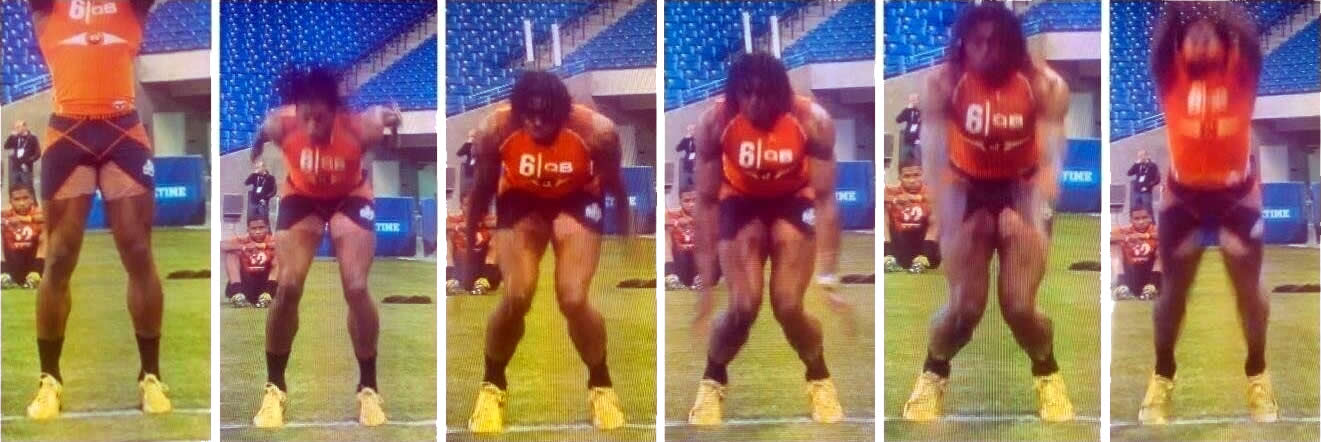 Yes, this is RGIII, and yes I’m comparing his jump form to a 15-year old volleyball player’s form.
Similar to the above picture, when we evaluate a volleyball player 99% of the time we see valgus collapse (knees coming  together- helloooo ACL tear!), knee-flexion dominance, loosey-goosey core, and usually, minimal arm swing involvement.
All these work against the poor girl and her goal of leaping high aloft to spike the ball into her opponent’s face. I’m going to briefly break down the mechanical flaws previously mentioned and then present a few drills we use to re-pattern the jump to create leaping, jumping, ball-spiking machines.
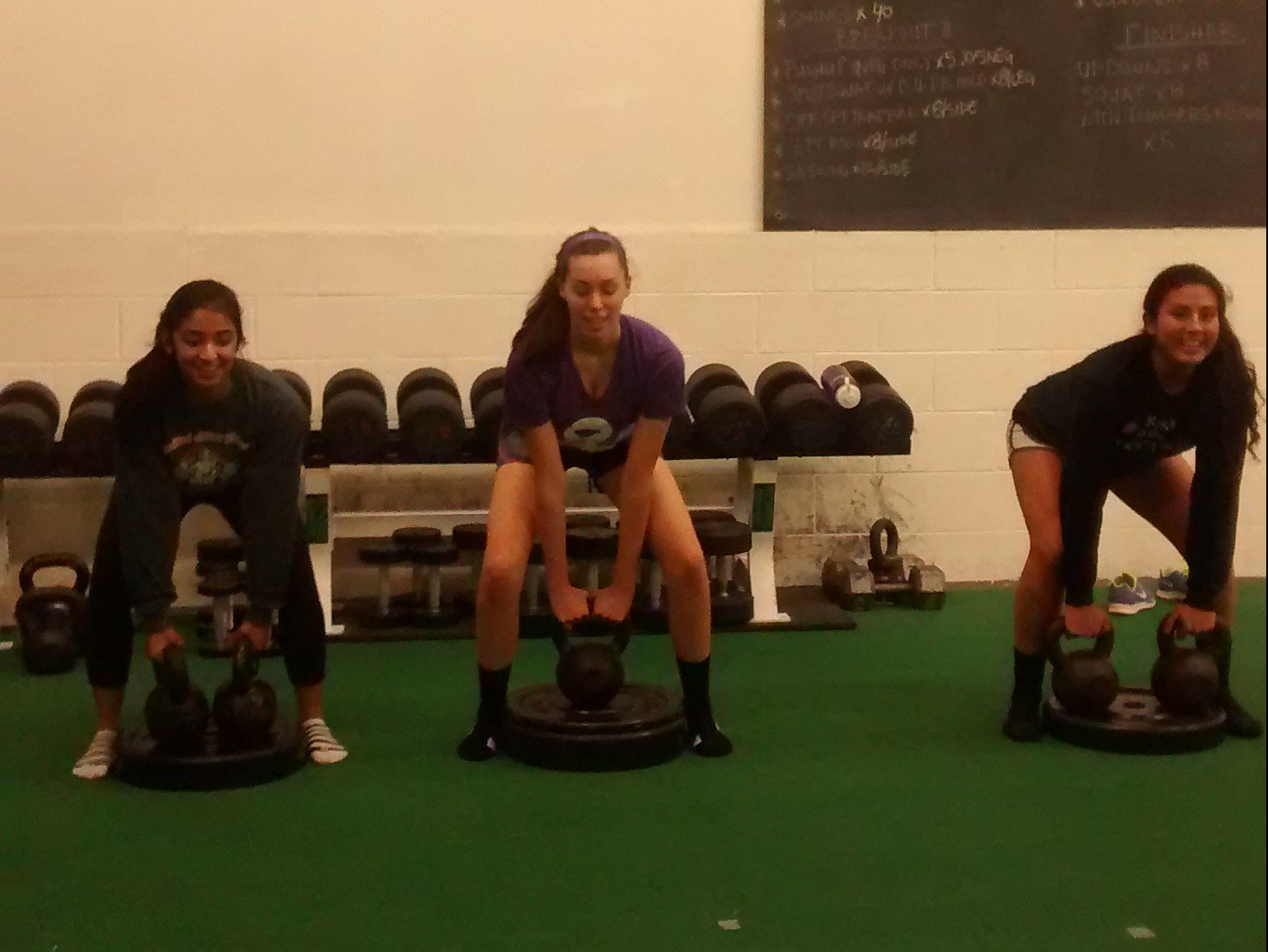
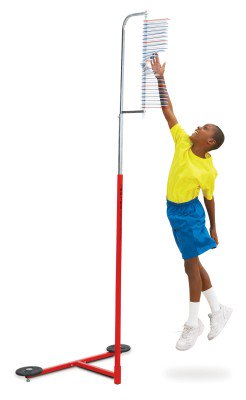
The posterior chain, that is, the glutes and hamstrings, are where it’s at when it comes to lower body power production. The glutes and hamstrings are way, way, WAY better at extending the hip than the quads (mostly because, the quads can’t do it at all). Quads are important in the vertical jump- as is knee extension- however, the power comes from the back. Athletes who don’t tap into their posterior chain will remain on the lower end of the VerTec.
So, how do we fix all this?
First we teach hip hinging without knee valgus collapse. The easiest way we’ve found is employing a dowel rod.
Coaching points:
Next, we put the hip hinge in context of a take-off/landing, but no jump. By eliminating the jump, the athlete can focus on his/her form.
Coaching points:
After the athlete masters the arm swing + hips, we move to a paused vertical jump. Again, the pause is there for the athlete to focus on the form before taking off. If they’re not in the right position, they can fix it- or rather, you the coach can fix it.
Coaching points:
Practice makes permanent, not perfect.
These three drills are SAPT’s basic jump technique teachers. We’ve seen great results and many girls add inches to their vertical just by becoming more efficient at the jump itself. I’d also like to point out that none of these use fancy equipment. So often it’s the simplest way that is the most effective!
Next week we’ll take a look at both strength exercises to increase vertical and some more specific drills for power production.


Unite your friends, family
and classmates, and
organize an event!

Advertisement
Advertisement